Freight API automation is the missing link between a well-designed transport strategy and the daily reality of booking freight. In our last post, we explored how strategic freight procurement — moving from rigid RFQs to qualitative RFPs backed by real data — can align cost efficiency and sustainability from the outset. But even the most sophisticated freight agreement is only as good as its implementation. The “Execution Gap” is the space between a signed contract and the moment a transport is actually booked. In many organisations, this is where the strategy falls apart.
Without real-time guidance, transport choices are often made based on habit or incomplete information. The result: cost leakage, missed emission targets, and a growing distance between the strategy your procurement team built and the reality your logistics team lives every day.
Decision fatigue at the booking desk
When an order is ready to ship, the person — or system — booking it faces a genuinely complex set of variables:
- Which carrier is most cost-effective for this specific weight and destination today?
- How do we prioritise the low-emission route without compromising the delivery deadline?
- Are we fulfilling the volume commitments we made during the RFP?
The problem isn’t people — it’s that the decision logic is too complex to apply manually, at speed, thousands of times a year. Expecting staff to calculate these variables by hand is unrealistic. And without automation, even the best-designed procurement strategy will be undermined by the daily reality of the booking desk.
Why your ERP or WMS can’t solve this alone
Most organisations already have systems in place: an ERP to manage orders, a WMS to manage the warehouse, perhaps a Transport Management System for carrier communication. The instinct is to assume that freight API automation is a problem these platforms should solve.
In practice, they can’t — at least not in isolation. These systems are built to manage process and data flow. They are not built to perform precise, real-time freight rate calculations across complex tariff structures, nor to calculate transport emissions in line with standards like GLEC or ISO 14083. The gap isn’t a missing platform; it’s missing intelligence. And that distinction matters, because the solution doesn’t require a system replacement.
Proxio as the intelligent layer in your existing workflow
This is where Proxio steps in — not as another platform to manage, but as the intelligence layer that makes your existing systems smarter.
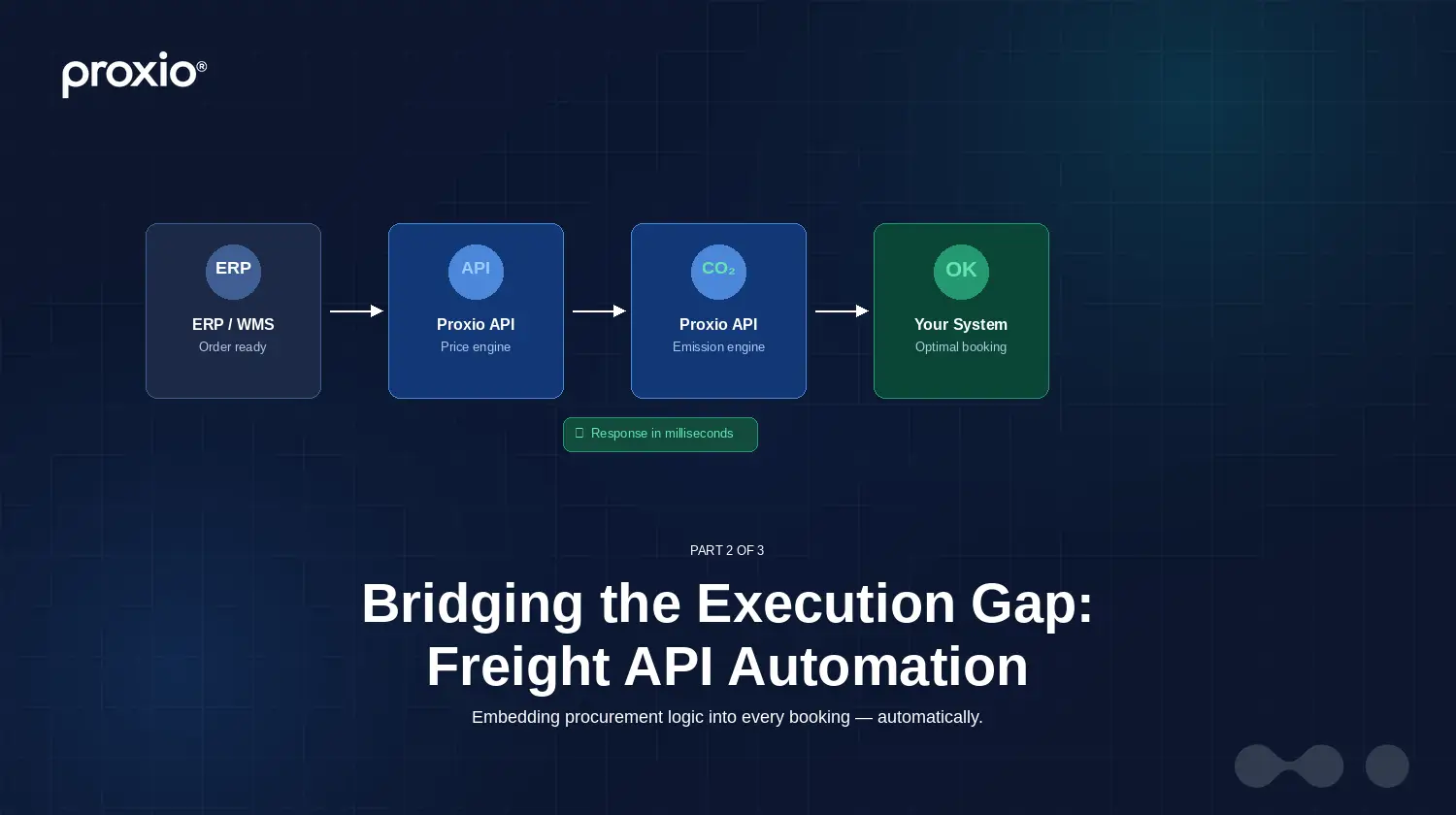
Through our API-first architecture, our Pricing and Emission Engines plug directly into your current ERP, WMS, or Transport Administration (TA) system. The data flow is straightforward:
- A shipment is triggered in your ERP or WMS as usual.
- An API call is made to Proxio’s Price Engine, which calculates the exact cost against your specific carrier agreements — including all surcharges, zone structures, and weight brackets.
- Simultaneously, the Emission Engine returns the carbon footprint for each routing option, calculated in line with recognised standards.
- Your system selects the optimal carrier based on the logic you define — lowest cost, lowest emissions, or a weighted balance of both — and the booking is confirmed.
The entire process takes milliseconds. Your teams don’t change how they work. Your systems don’t need to be replaced. The procurement strategy you designed simply becomes the decision logic that governs every booking, every time.

What your teams stop doing — and start doing instead
The practical impact of closing the Execution Gap is felt most clearly at the operational level. When freight API automation is in place:
- Planners stop manually calculating surcharges and reconciling rate cards. The correct price is returned instantly, against your actual agreements.
- Logistics managers stop chasing compliance reports. Volume commitment tracking happens automatically, so you always know where you stand with each carrier.
- Sustainability leads get accurate emission data per shipment without a monthly reconciliation exercise — the figures are generated at the point of booking, not reconstructed afterwards.
- Finance teams stop absorbing unexplained cost variances. When every booking is made against verified rate logic, cost leakage drops significantly.
The strategic value isn’t just efficiency — it’s confidence. Every stakeholder in your organisation can trust that the transport choices being made today reflect the agreements and targets you set during procurement.
Summary
Closing the Execution Gap requires automation, not effort. By embedding Proxio’s Price and Emission Engines directly into your existing systems via API, your freight strategy stops being a document and starts being a decision engine — one that operates at the speed and scale your supply chain demands. The result is fewer manual errors, lower cost leakage, and emission data you can actually trust.
In our final post, we explore the Fact-Based Supply Chain — how automated audit and invoice control closes the loop and turns every shipment into verified, optimisation-ready data.
The execution gap is the discrepancy between a company’s strategic freight procurement (contracts with rates and pricing structures & sustainability goals) and the actual day-to-day booking of shipments. It often occurs because manual booking processes rely on habit or incomplete data rather than real-time contract compliance and emission targets.
Freight API automation eliminates “cost leakage” by instantly calculating the most cost-effective carrier and route based on your specific contract tariffs. By integrating these calculations directly into your ERP, WMS or TMS, you ensure that every shipment follows your negotiated rates, surcharges, and volume commitments.
Yes. Modern solutions like Proxio act as an “intelligent layer” that plugs into your existing ERP, WMS, or TMS via API. This allows you to automate complex price and emission logic within the workflows your team is already using, avoiding the cost and risk of a full system replacement.
Most companies calculate emissions retrospectively, which makes it impossible to influence the carbon footprint of a shipment once it’s sent. By automating emission calculations via API at the point of booking, logistics teams can compare the environmental impact of different carriers and routes in real-time, making sustainable choices a daily reality.
A sophisticated Freight Pricing Engine uses API automation to process thousands of variables; including fuel surcharges, weight brackets, and geographic zones – in milliseconds. This ensures that the price returned to your booking system is 100% accurate according to your specific carrier agreements.