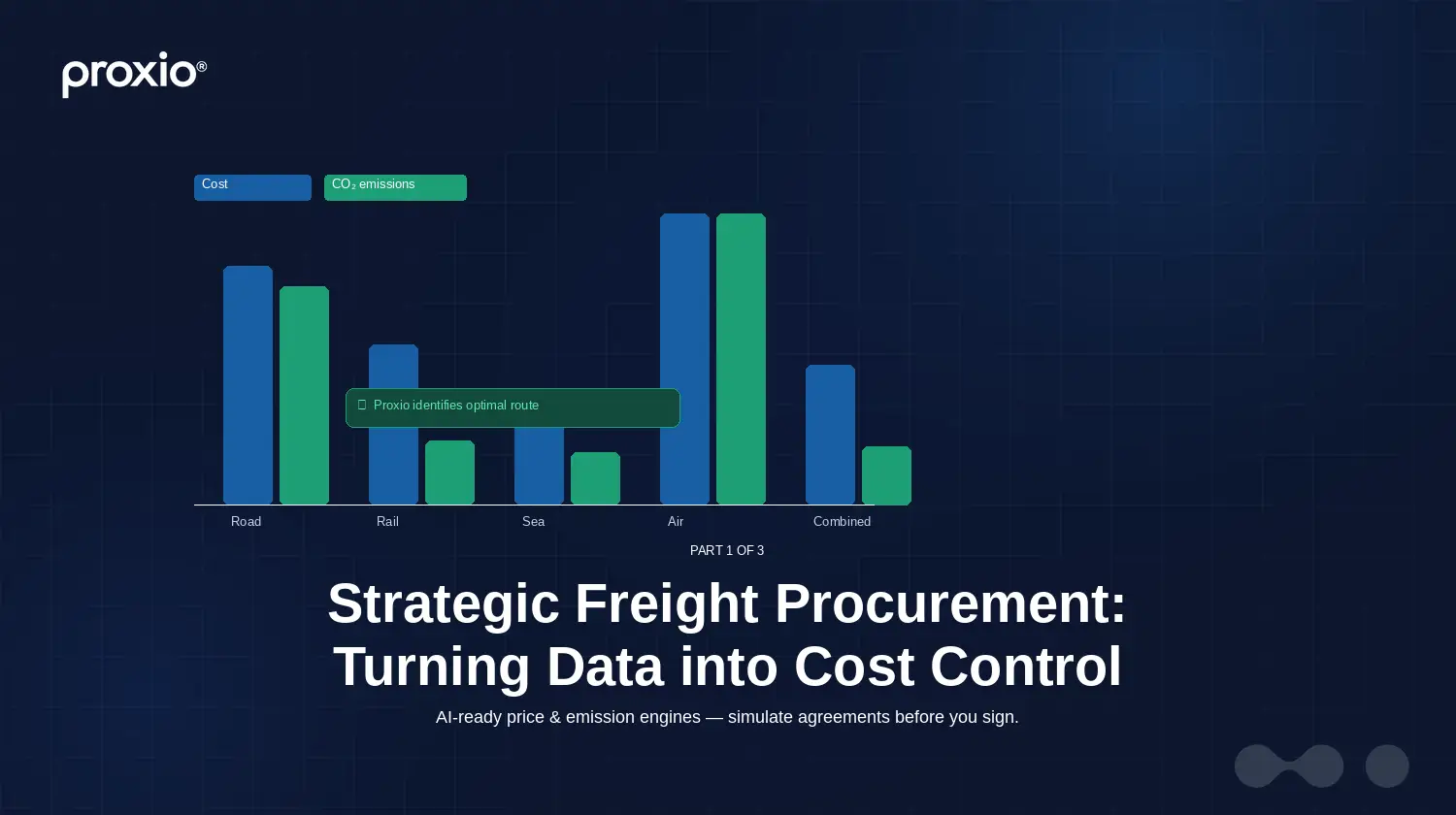
For a long time, the standard approach in strategic freight procurement was simple: “Lower the price per shipment.” But in today’s landscape, the “cheapest” option often hides the highest risks and the heaviest carbon footprint. We are entering an era where real cost control isn’t found in a simple discount – it’s found in optimization.
The perceived conflict between sustainability and cost-efficiency is a relic of the past. When you look at the big picture, they are two sides of the same coin. Waste, whether it’s empty kilometers, inefficient routing, or poor fill rates, is a burden on both the planet and your profit margin.
Leading industry research confirms this shift. McKinsey highlights that companies are increasingly integrating sustainability into logistics as a core driver of both cost efficiency and competitive advantage, not as a trade-off (External link).
Moving from Rigid RFQs to Qualitative RFPs
Many companies get stuck in a traditional RFQ (Request for Quotation) loop, where carriers are forced into rigid templates that only measure price per pallet, container or weight bracket. This transactional approach leaves very little room for innovation or sustainable design.
By shifting to an RFP (Request for Proposal), you open a strategic dialogue. You can challenge your transport providers to design solutions that hit both of your key targets:
- Alternative Proposals: Invite carriers to present a “lowest cost” solution alongside a “lowest carbon footprint” solution.
- Dynamic Modeling: What happens to the total cost and lead time if you shift from road to rail on a specific corridor? What is the actual cost impact of reducing emissions by 20%?
The Challenge: Handling Data Complexity in Strategic Freight Procurement
The barrier to this strategic approach has always been the sheer complexity of the data. Manually comparing multi-dimensional proposals – each with different surcharges, zone structures, and emission metrics – is a massive task and often prone to error.
This is where Proxio platform empowers your organization. We don’t require you to replace your existing systems or redesign your IT landscape. Instead, we add the intelligence needed to turn your data into clear, actionable insights.

An AI-Ready Engine via API
Our solution is a high-performance Price and Emission Engine designed to act as the “mathematical truth” for your procurement team.
- Precision Modeling: We calculate the exact cost against your specific agreements, including all complex surcharges, while simultaneously calculating the environmental impact.
- AI-Ready Logic: Because our engines are API-based, they are built for the modern tech stack. They can be queried within an AI context, providing the structured, high-quality data that AI agents or predictive models need to make informed, sustainable decisions.
- Simulate Before You Sign: Before you commit to a new agreement, our engine allows you to run your historical shipment data through new contract proposals. You get an instant, factual report on the actual cost and carbon impact.
Summary
Strategic freight procurement starts with having better data than the competition. By focusing on a qualitative process and supporting it with Proxio’s specialized, AI-ready engines, you ensure your supply chain is built on a foundation of facts, not guesswork.
In our next post, we will explore the “Execution Gap” and how to use API-driven automation to ensure your procurement strategy actually survives the reality of daily operations.