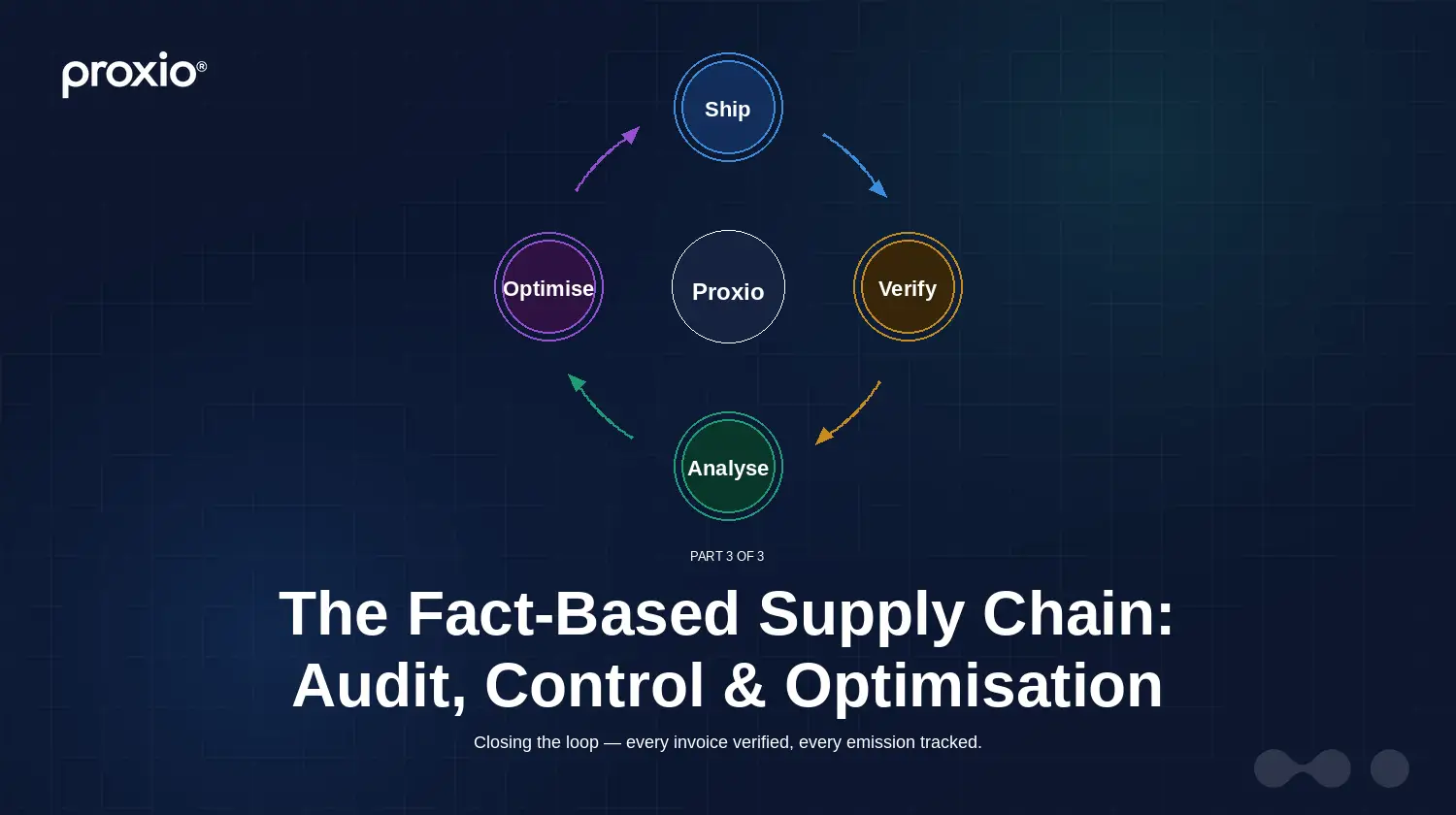
You have negotiated the contracts. You have automated booking through the API. The strategy is in place, the systems are connected. Now comes the freight invoice audit moment — the question that decides whether any of it actually worked: did what happened in your operations match what you planned?
This is where the third stage of freight management lives — the freight invoice audit. Not in negotiation, not in booking, but in the follow-up. And it is where most supply chains quietly lose money and credibility.
Why freight invoice audit is hard
Freight invoices are not like other invoices. A single one can carry dozens of moving parts: the base rate, fuel surcharges that change month to month, currency adjustments, regional fees, accessorials triggered by something a driver did at the dock. Industry studies typically place freight invoice overpayments in the range of 3 to 5 percent of total freight spend — simply because invoices are too complex to verify line by line.
If you are not checking each invoice against the exact logic of the contract you signed, you are almost certainly paying more than you should.
The same applies to sustainability. Most CO2 reporting in freight is still top-down — annual averages, generic assumptions, numbers that nobody can really stand behind. The way to fix that is to flip the logic. Calculate the footprint at shipment level, on the transport that was actually performed, and build a bottom-up dataset you can follow up on month by month, lane by lane, customer by customer.

That also lets you ask the harder question: did we hit not only the cost targets we set in procurement, but the emission targets too? If a carrier ran a high-emission route when the contract called for a lower-emission alternative, you can see it — and you have the numbers to do something about it.
You need a reference point you can trust on both sides, cost and CO2. A version of the truth the invoice can be checked against.
Proxio as the reference point
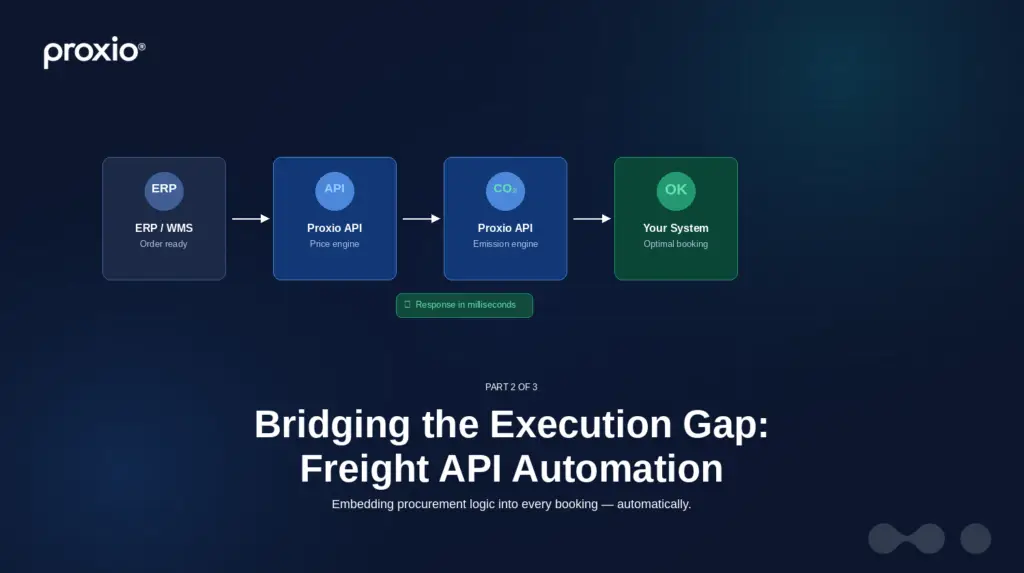
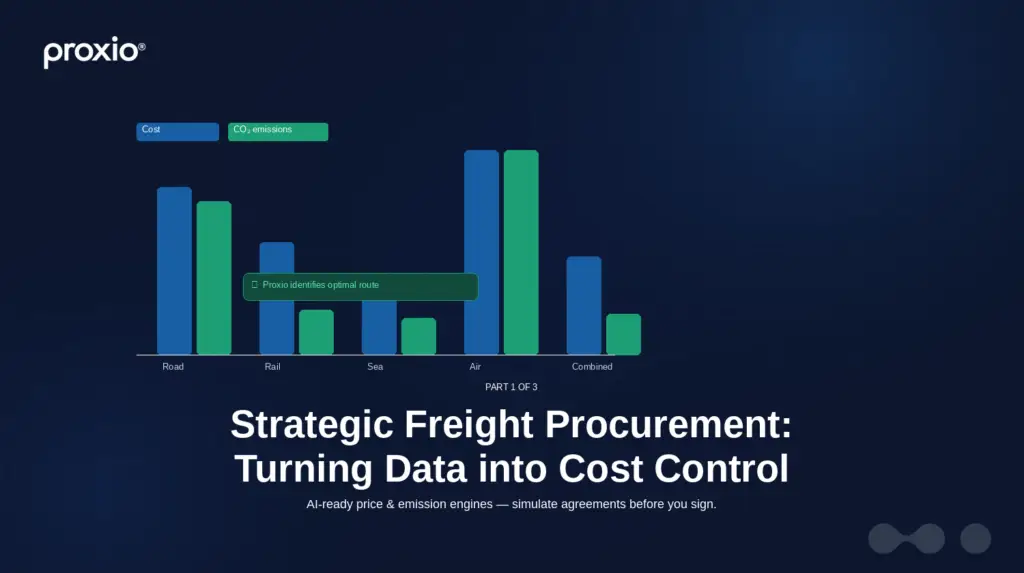
Once the contract is negotiated, the rates are loaded into Proxio (Part 1). From there, they become the source of truth for the rest of the cycle — visible to your teams, your partners, and the connected systems that need them. Through the API, those same rates are used for daily booking and execution (Part 2).
That means Proxio already knows what every shipment should have cost. With Proxio Emissions in the picture, it also knows what each shipment’s CO2 footprint is. The data needed to audit the invoice is already there. It just needs to be put to work.
When you wire the Proxio engine into your invoice or freight audit workflow, three things change:
- Invoices are checked automatically. Each incoming invoice is matched against your contract logic, line by line. Discrepancies are flagged when they happen, not three months later in a year-end review.
- Your data becomes usable. Freight data is famously messy — different carriers, different formats, different definitions of the same field. Proxio cleans and structures it, so your team, and any analytics or AI tools you layer on top, work with data that is consistent and reliable.
- Each cycle improves the next. What you learn from this year’s invoices feeds the next RFP. Over time, the surcharge patterns you keep seeing in invoices stop being surprises and start becoming things you negotiate out of the next contract.
Closing the loop
Cost control and sustainability are not separate disciplines. They are what happens when operations are run with precision. By making Proxio the source of truth for freight rates and emissions, you have:
- Made the negotiated rates visible — to internal teams, partners, and connected systems that need them.
- Executed through the API — on rates and emission factors calculated the same way, every shipment.
- Verified with structured audit logic — against the contracts you actually signed.
It’s the same supply chain you had before. It just runs on numbers you can defend.
Series wrap-up
This closes our three-part series on combining sustainability with cost control. The pattern across all three parts is the same: when the data is clean, the decisions get easier — for procurement, sustainability, and finance, all at once.
If you want to see what this looks like in your own data, book a free 30-minute session with one of our logistics experts. We will walk through your specific setup and show where the loop is still open.